

For more than two decades, SEO professionals have focused on a familiar formula.
While these fundamentals remain important, recent developments suggest that search visibility is entering a new phase.
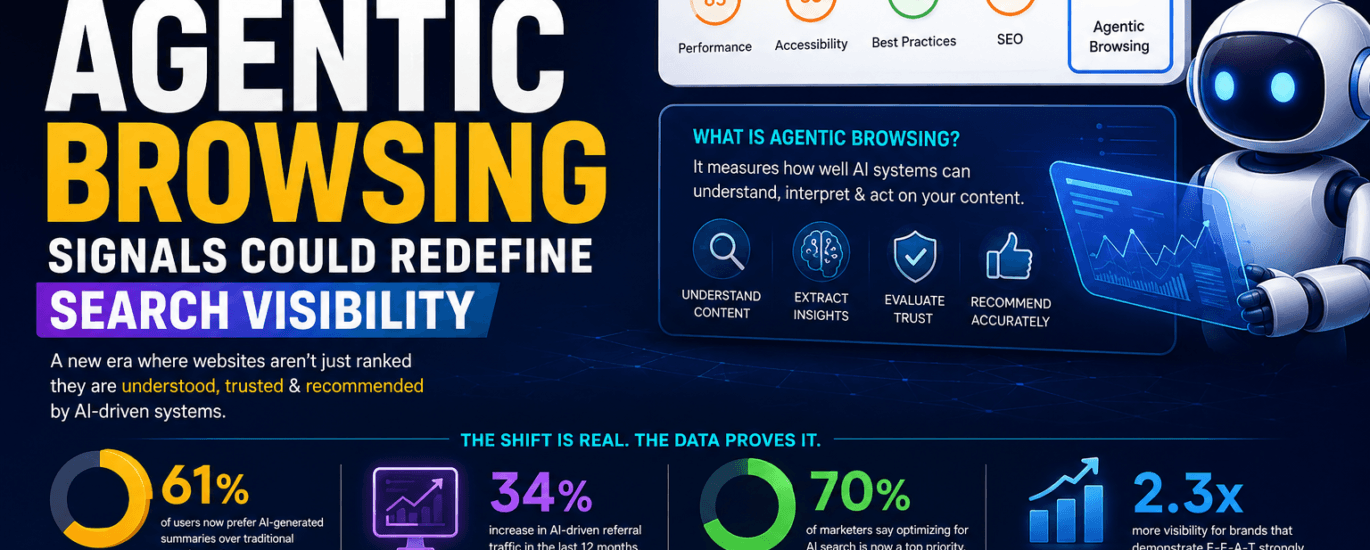
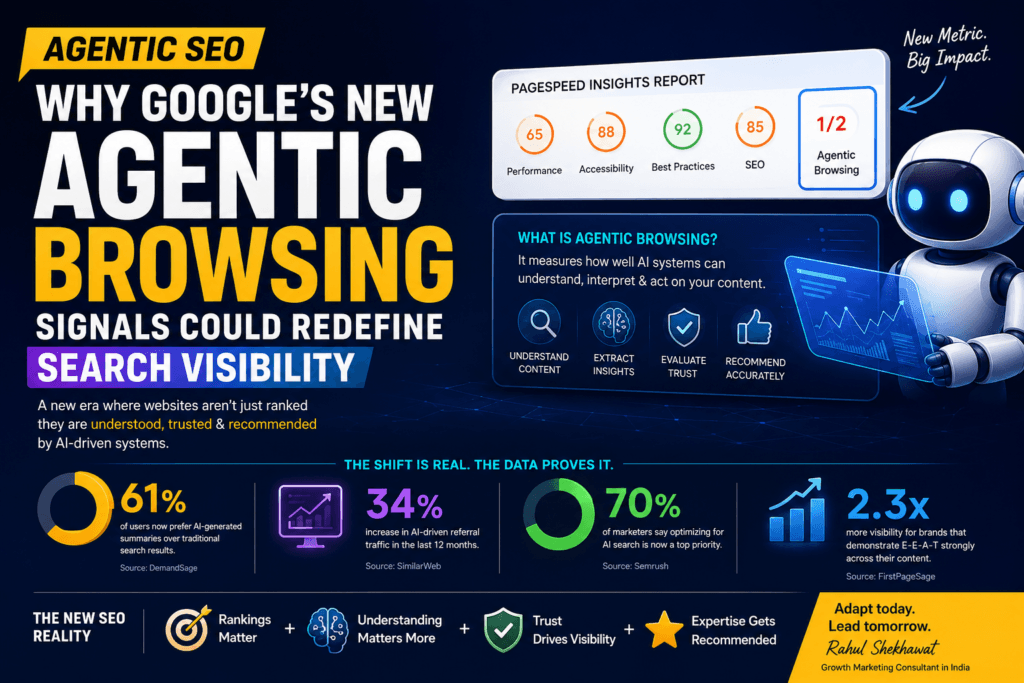
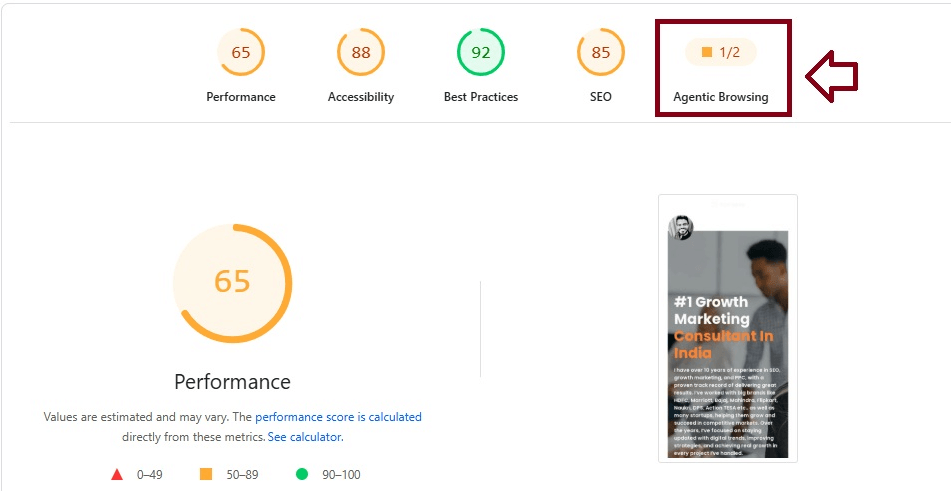
A new metric called Agentic Browsing has started appearing within Google PageSpeed Insights, and it has already raised important questions across the SEO community.
What makes this particularly interesting is that some websites are achieving excellent SEO scores while still receiving poor Agentic Browsing evaluations.
That observation alone tells us something significant.
Google may no longer be evaluating websites only on how well they can be crawled and indexed.
It may also be evaluating how effectively websites can be understood, interpreted, and utilized within AI-powered search experiences.
For businesses, consultants, marketers, and publishers, this is not simply another technical metric.
It could represent the early foundation of how websites will be discovered over the next decade.
Agentic Browsing appears to evaluate whether a website can be easily interpreted and utilized within AI-assisted experiences.
Traditional search engines focus primarily on discovering, crawling, and ranking pages.
Modern search systems are increasingly focused on understanding information.
Instead of simply identifying keywords, these systems attempt to understand:
In simple terms, Agentic Browsing appears to measure how effectively your website communicates information—not only to humans but also to modern search systems.
A technically optimized website can still struggle if its content lacks structure, context, authority, or clarity.
Historically, SEO success was measured through rankings.
If your website ranked on page one, the strategy was considered successful.
Today’s search environment is becoming far more complex.
Users increasingly interact with:
These platforms do not simply rank content.
They determine which sources deserve visibility.
As a result, future SEO success may depend on much more than rankings alone.
Websites that communicate expertise clearly and consistently are likely to gain a competitive advantage.
After reviewing multiple websites and testing Agentic Browsing reports, a pattern begins to emerge.
Many websites have invested heavily in traditional SEO best practices.
They have optimized title tags.
They have improved page speed.
They have built backlinks.
They have targeted keywords effectively.
However, many of these same websites struggle in areas that influence understanding and trust.
Common weaknesses include:
• Thin author information
• Weak content depth
• Poor internal linking
• Limited topic coverage
• Generic blog content
• Lack of supporting evidence
• Missing structured data
• Weak demonstration of expertise
This creates a gap.
The website may be visible. But it is not necessarily understood.
Traditional SEO and Agentic SEO should not be viewed as competitors.
Instead, they represent two layers of the same strategy.
Traditional SEO focuses on helping search engines discover and rank content.
Agentic SEO focuses on helping search engines understand and trust content.
“Can Google find this page?”
“Can Google confidently recommend this page?”
That distinction is becoming increasingly important.
The good news is that most improvements align with practices that already create better user experiences. The objective is not to optimize for machines. The objective is to communicate expertise more effectively.
Many websites still approach content creation as a keyword exercise.
One blog targets one keyword.
Another blog targets another keyword.
Over time, the website becomes a collection of disconnected articles.
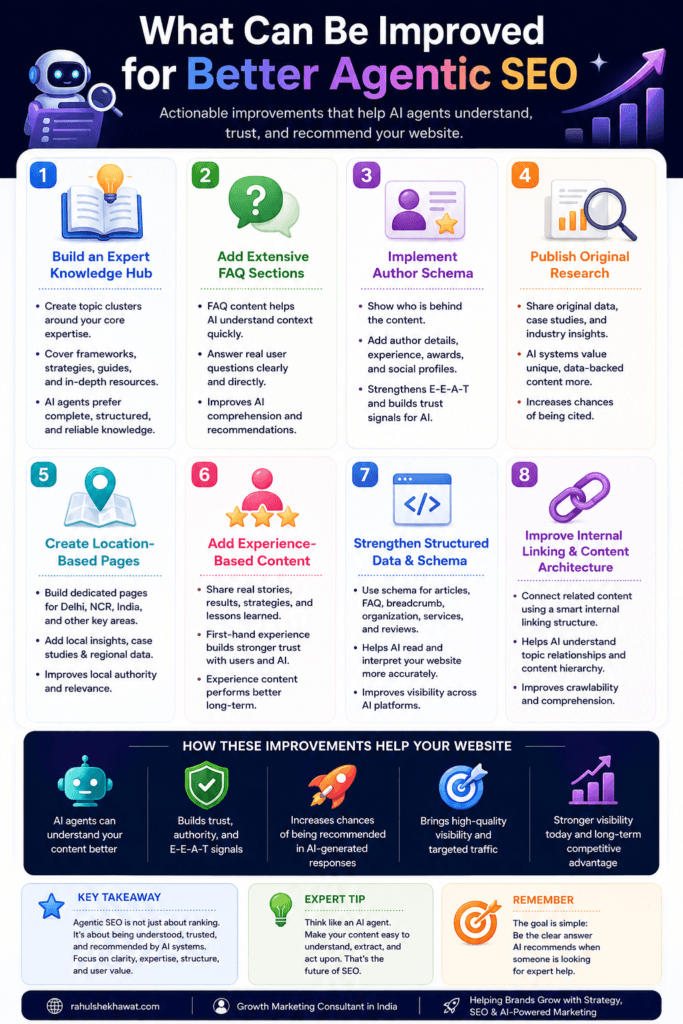
Search engines increasingly reward websites that demonstrate complete expertise within a subject area.
Instead of publishing random SEO articles, create comprehensive topic ecosystems.
For example:
• Customer Acquisition
• Growth Frameworks
• Conversion Optimization
• Demand Generation
• Revenue Growth
• Technical SEO
• Local SEO
• Entity SEO
• Agentic SEO
• Generative Engine Optimization
The stronger the relationship between topics, the easier it becomes for search engines to understand expertise.
One of the biggest mistakes businesses make is publishing content that could have been written by anyone.
Search engines already have access to millions of generic articles.
What they value is original experience.
Share:
Modern SEO increasingly evaluates the people behind the content.
A well-written article becomes far more valuable when readers can clearly understand who created it.
Every important article should communicate:
For consultants and personal brands, author authority is becoming one of the strongest long-term ranking assets.
Many service pages focus entirely on selling.
Users are looking for solutions.
Search engines recognize this.
A stronger service page explains:
Pages that educate tend to perform better than pages that simply promote services.
Schema markup provides additional context about your content.
Many websites implement only the basics.
Priority schema opportunities include:
Original research has become one of the strongest authority signals available.
Data-driven content naturally attracts:
Research-based content is also more difficult for competitors to replicate.
That creates a sustainable advantage.
For consultants targeting regional markets, local relevance remains essential.
Pages targeting Delhi, NCR, Gurgaon, Noida, or India should include unique regional insights.
Avoid simply replacing city names.
Instead, discuss:
This creates genuine local expertise.
When reviewing RahulShekhawat.com, the website already demonstrates several positive signals.
The site has established relevance around:
The website also benefits from strong personal branding and targeted keyword visibility across India and Delhi NCR.
However, the next phase of growth should focus less on expanding keyword volume and more on expanding authority.
Areas of opportunity include:
The objective should not be ranking for more keywords.
The objective should be becoming one of the most trusted marketing resources in India.
The future of search is increasingly centered around trust.
Search engines are moving beyond simple keyword matching.
They want to understand who deserves visibility.
This is where individual expertise becomes important.
Professionals who consistently publish insights, share real-world experience, and contribute original perspectives are likely to gain greater visibility than those relying solely on traditional optimization techniques.
Authority is becoming a ranking factor in its own right.
Not because search engines reward popularity.
Because users reward trust.
And search engines follow users.
Agentic SEO is still in its early stages, and no single platform can fully optimize your website for AI-driven search. However, a new generation of tools is helping marketers understand how search is evolving—from traditional rankings to AI recommendations, entity recognition, and search automation.
If you’re serious about preparing your website for the future of search, these platforms are worth exploring:
From my experience working with businesses across India, I’ve learned that tools don’t create authority—your expertise does. These platforms can automate research, monitor AI visibility, and uncover optimization opportunities, but they cannot replace original thinking, industry experience, or a well-defined SEO strategy.
My recommendation is to use these tools as decision-support systems, not decision-makers. The websites that will dominate the next generation of search won’t be the ones using the most AI tools; they’ll be the ones combining strong technical SEO, topical authority, first-hand expertise, and high-quality user experiences with intelligent automation.
In the era of Agentic SEO, technology gives you speed—but expertise builds trust, and trust is what search engines increasingly reward.
Agentic Browsing may still be in its early stages, but the message is already clear.
Future search visibility will depend on more than technical SEO.
Businesses that focus exclusively on rankings may find themselves struggling as search experiences evolve.
The websites that succeed will be those that combine:
SEO is no longer just about helping search engines find content.
It is about helping search engines understand why your content deserves to be recommended.
That is the direction search is heading.
And businesses that adapt early will have the strongest advantage moving forward.
Agentic SEO is the practice of improving how search engines and AI-driven search experiences understand, evaluate, and recommend your content.
No. Traditional SEO remains essential. Agentic SEO builds on top of existing SEO practices by focusing on trust, expertise, context, and understanding.
Because technical SEO and content understanding are different evaluations. A website may be optimized for crawling while still lacking authority, structure, context, or expertise signals.
Google has not officially confirmed ranking impacts, but it likely reflects signals that will become increasingly important as search evolves.
Focus on demonstrating expertise, publishing original insights, strengthening author authority, improving content structure, and building comprehensive topic coverage.


No Related Post