Why SEO Still Matters in the Age of AI and Geo-First Search Models
Rahul Shekhawat > SEO > Why SEO Still Matters in the Age of AI and Geo-First Search Models
In an age where AI-driven search models and Geo-first strategies are gaining prominence, many marketers wonder if traditional SEO still holds its ground. The reality is, SEO is more important than ever—it has simply evolved. Let’s explore why SEO continues to play a vital role in 2026 digital marketing strategies, even in the face of powerful technologies like AI and geo-location-based search paradigms.
The Evolution of SEO: From Keywords to Context
In the past, SEO was heavily reliant on keywords, backlinks, and traffic generation. The goal was to rank higher on search engines by optimizing individual page elements such as titles, meta descriptions, and H1 tags. But as we dive deeper into 2026’s evolving search ecosystem, search engines have become much smarter. AI is now at the core of how results are generated, relying not just on the raw content of a page, but also on **context, relevance, and user intent.
AI and the Synthesize-and-Retrieve Framework: A Game Changer
AI-driven search models (especially those powered by Large Language Models, or LLMs) are designed to synthesize information, meaning they pull together data from multiple sources and present a comprehensive answer to users without needing them to click. This new Retrieve-and-Synthesize framework is based on AI models understanding not just individual search results, but also how they relate to user intent and semantic meaning.
Here’s why this shift matters:
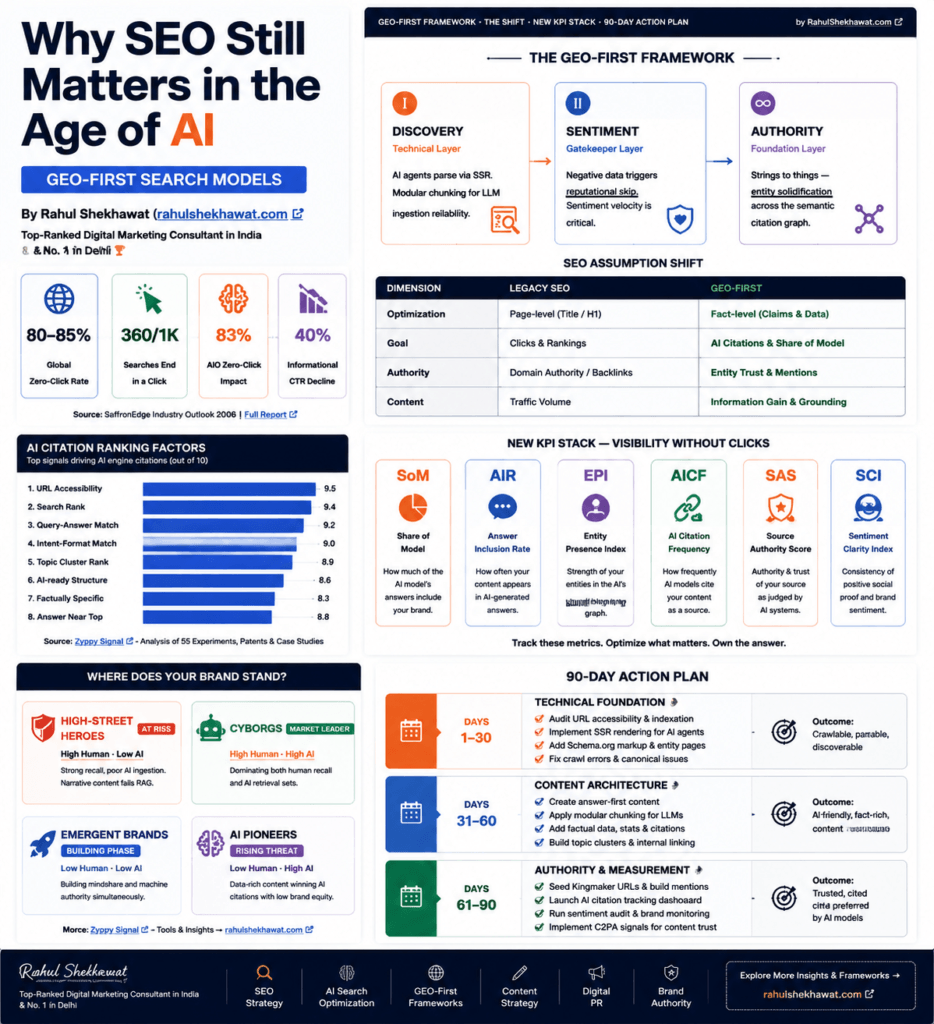
83% of searches in 2026 will be zero-click searches, meaning users will get direct answers from AI-driven results.
AI-enhanced systems prioritize answering the query over just ranking pages based on backlinks, improving user satisfaction by immediately providing the most relevant and accurate data.
However, SEO is still central to making sure your content is visible in these AI-generated answers. This is where structured data, entity mentions, and content relevance play a crucial role.
Geo-First: The New Local SEO
Geo-first frameworks emphasize localization and context-aware search results based on geographical relevance. This shift means that in 2026, if you’re not optimizing your content for location-based queries, you’re missing out on a huge portion of your target audience. Geo is no longer an afterthought—it’s now a core part of how AI understands and presents search results.
For example, if you run a business in Delhi, AI systems will likely prioritize content that is locally relevant, understanding the proximity to the user’s search and providing results that fit the local context. This means that Geo-first SEO will focus on:
Geo-tagging your content for better local search ranking.
Optimizing for local queries, ensuring your content is structured with geo-relevant data.
This localization goes hand in hand with AI search models, as they leverage data from local entities and geographic locations to make real-time decisions on which information to present to users.
SEO, AEO, and Geo: How They Work Together
Here comes the most important question: Why does SEO still matter when AI and Geo are on the rise?
SEO Ensures Content Visibility: SEO ensures that your content remains discoverable, even in an AI-first world. AI models rely on structured data and entity mentions to properly index and synthesize content. If your content isn’t optimized for SEO, it won’t appear in AI-driven results.
AEO (AI-Enhanced Optimization) Is Built on SEO Principles: Even though AEO is specifically designed to enhance content for AI synthesis, it still relies on SEO techniques such as semantic structure, entity consistency, and metadata optimization. This is why SEO experts are still crucial in building AI-optimized content.
Geo SEO Increases Local Relevance: As AI prioritizes location-based searches, Geo-first frameworks allow you to optimize your brand’s local presence, ensuring it ranks in AI’s local knowledge graph. Without local SEO, AI search engines might miss out on your content.
Technical Data and Surveys: Real Insights Into SEO’s Role in AI
According to recent industry reports, 85% of searches today are driven by zero-click results. In the U.S., over 360 million searches end without a click, and this number is expected to rise. This means that AI is providing answers directly on the search results page without users needing to click on a link.
Here’s a deeper look into some critical SEO metrics that align with AI and Geo-first strategies:
AI Citation Frequency (AICF): AI citations are essential for ensuring your brand’s visibility in AI-synthesized results. AICF is a key metric that measures how often AI systems use your content as a reference. This metric is gaining in importance as AI-driven content becomes more integrated into search engines.
Entity Trust: Entities play a crucial role in how AI ranks content. For instance, Brand Authority and Entity Mentions significantly impact how AI evaluates the trustworthiness of a content piece. SEO is still vital in ensuring these entities are correctly linked and cited across your content.
Entity Consistency: AI requires content to be semantically consistent. If your content lacks consistency across multiple touchpoints (e.g., website, social media, and AI data sources), it risks being ignored by AI-driven systems. SEO experts work to ensure that entity references remain consistent and reliable.
SEO, AEO, and AI: Common Challenges and Solutions
Challenge: Integrating AI and Geo-first into existing SEO strategies can be technically complex.
Solution: Start by focusing on structured schema markup and geo-tagging your content. Integrating both AI and SEO techniques with structured data helps search engines and AI models better understand the context of your content.
Challenge: Achieving local relevance without sacrificing global visibility.
Solution: Build a Geo-optimized SEO strategy that includes location-based keywords, geo-specific content, and location data. At the same time, ensure that global SEO principles such as backlinks and content quality are not ignored.
Challenge: The risk of your content becoming invisible in AI-driven, zero-click search results.
Solution: Optimize for AI Citation Frequency (AICF) and entity mentions. This ensures your content is frequently referenced and included in AI-driven snippets.
Conclusion: SEO Still Holds the Key to Digital Success
Despite the rise of AI-enhanced search models and the Geo-first framework, SEO remains essential. It not only complements new AI and Geo strategies but forms the foundation on which they are built. Brands must optimize for AI, geo-targeted queries, and semantic content to stay relevant.
By focusing on SEO, AEO, and Geo optimization, businesses can ensure they stay visible, increase trust, and remain competitive in the rapidly changing digital landscape.